
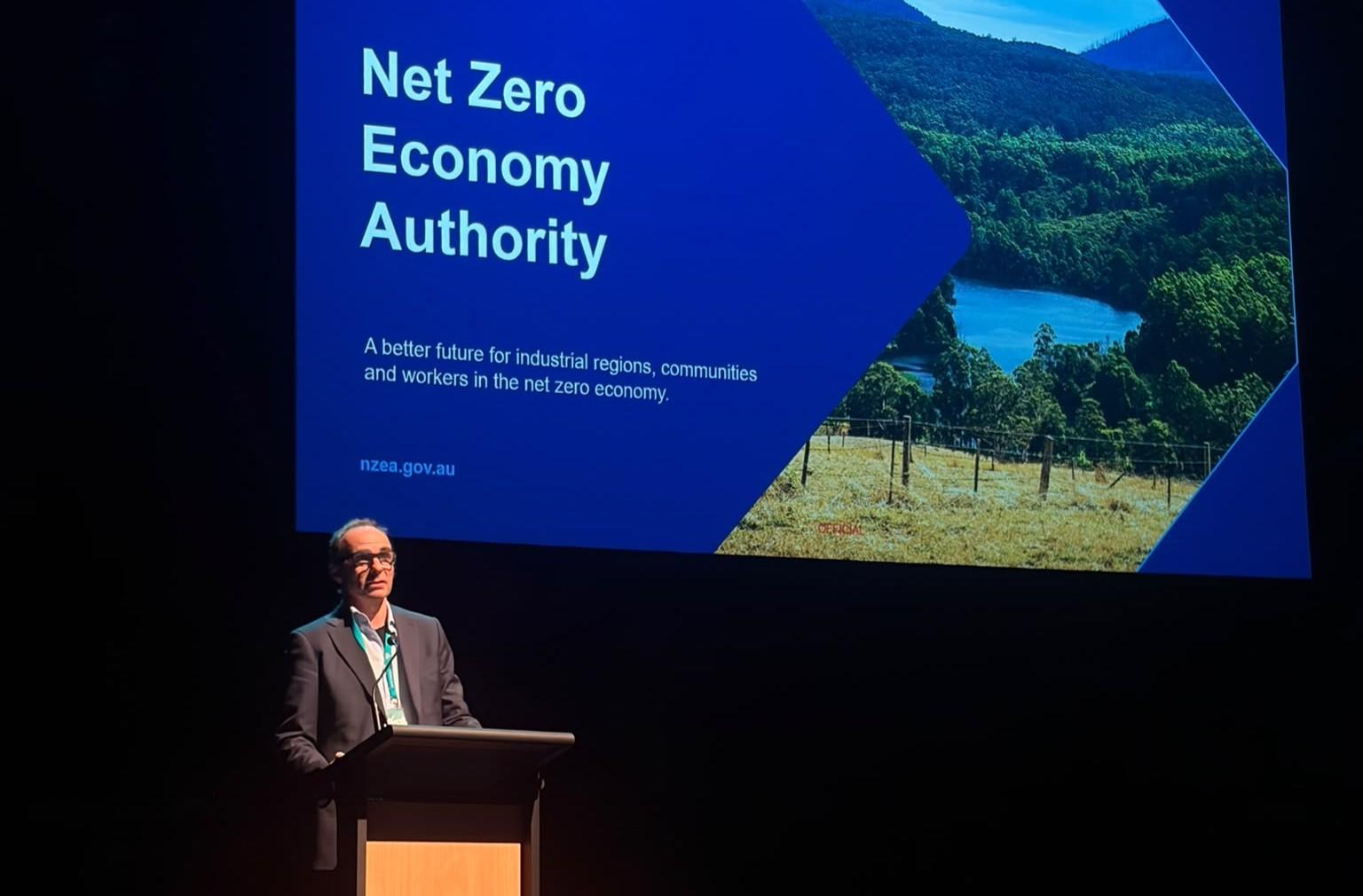
Address to the Gippsland New Energy Conference 2026 – David Shankey, NZEA CEO
CHECK AGAINST DELIVERY
Hello, I am David Shankey – CEO of the Net Zero Economy Authority. I acknowledge the Traditional Owners of the land on which we meet today, the Gunaikurnai people. I also acknowledge First Nations leaders and community members.
An important part of an economic transition of this scale, which is going to unfold over the next 30 years, is ensuring First Nations people are empowered to participate, shape decisions and benefit, from the beginning. That is the practical legacy question.
Thank you to everyone who has contributed to bringing this event together.
We are a young organisation and worth take a moment to explain who we are. Still very much a new kid on the block in Canberra and in the region. The Net Zero Economy Authority was established to support workers, communities and regions through the net zero transition. We have 3 connected missions:
- support workers in closing coal- and gas-fired power stations to transition to new opportunities
- enable regional economic transformation for communities significantly affected by the net zero transition
- build understanding and bring regional evidence into national decision-making.
For Latrobe and the broader Gippsland region, that means practical work to support transitioning workers and foster industry and jobs growth for enduring regional benefit. We have now been working in this region for just over a year, engaging with industry, unions, local and state government, Traditional Owners, education providers, businesses and community organisations. This has given us a much clearer view – that we are bringing back to Canberra – of where the opportunities are, what the barriers and enablers are, and where coordinated actions can materially drive industrial growth and pathways for workers, businesses and communities as coal facilities close.
We operate in 6 different regions at different levels of intensity. Every region has a different story. Coal has long been part of Gippsland’s narrative. In June 1924, electricity generated at Yallourn first reached Melbourne. At the time, it was one of the largest infrastructure projects Australia had ever undertaken. But it wasn't just a power station. We should all remember the State Electricity Commission built an entire town. Yallourn was constructed to house workers and their families and grew to around 5,000 residents at its peak.
Before we even mentioned the term social licence, energy and mining companies were building entire communities across the nation. The power stations became part of the skyline. The mines became part of the landscape. Families built careers, businesses, skills and identities around that role.
When we started the NZEA and were looking at the region from afar through research, we estimated the Latrobe Valley employs around 1,250 fossil fuel workers as of 2024, around 3.5% of the region’s total workforce, many with specialised skills. We were making the case to government that these skills are a significant asset for what comes next. This is a region that already has strong local leadership, institutions and networks doing the work of planning for what comes next, which the NZEA is seeking to bring together and add to. The region is adapting to the end of native timber harvesting and changes across other heavy industries.
At the same time, Victoria's energy system is changing. New generation, storage and transmission are coming online. As the world changes, new supply chains, manufacturing and investment trends are also emerging as countries decarbonise, electrify and invest in sovereign industrial capability.
That is the opportunity that the Future Made in Australia agenda is looking to capitalise on. With new investment looking for places to land, our role at the NZEA is to ensure a share of that happens here in Latrobe and Gippsland.
To understand the scale, it's worth stepping back and looking at the region itself. Home to more than 311,000 residents, supporting more than 147,000 jobs and contributing around $24.5 billion to the Victorian economy. As we've worked across the region, one thing is clear: this area has heard a lot of talk about opportunity.
The challenge is converting that talk into lasting economic and community value. The Authority's focus in the past year has been identifying barriers and enablers, making the case for coordinated actions, finding pathways for government supports and looking for how the Commonwealth can act as a ‘force multiplier’ to all existing efforts.
That focus starts with the workers whose industries are changing in the next 2 years. Yallourn's planned closure in 2028 sharpens the mind in this area and makes workforce transition an immediate priority. Our on the ground analysis – as opposed to the one done from Canberra – showed the closure could affect more than 500 permanent staff, and up to 1000 during maintenance, and supply chain businesses. Energy Australia estimates each Yallourn power station worker generates an additional 4 to 5 jobs in the region.
This is one area where the NZEA is very focused. The Energy Industry Jobs Plan (EIJP) is a regulatory framework that aims to help workers from closing coal- and gas-fired power stations and affected supply chain businesses to prepare for new jobs. NZEA has undertaken an assessment process, engaging workers, unions, employers and regional stakeholders to understand who is affected and the transition supports required.
Based on the information received and what I heard during that process, in June I applied to the Fair Work Commission to establish an Energy Industry Jobs Plan for the closure of Yallourn Power Station. This application is currently before the Commission. The application names a suite of companies involved in the closure. Together, these companies employ 91% of workers who may be impacted.
While the Energy Industry Jobs Plan ensures businesses are primarily responsible for supporting their workforce to prepare for transition, NZEA is developing a range of redeployment supports to complement existing and expected efforts from employers. Our practical focus is on identifying future opportunities for those workers who will lose their job when Yallourn closes in mid-2028. We are building a pool of local employers – here in the region – that are looking to hire across a range of roles, including:
- trades and technicians – electrical, instrumentation, fabrication, welding, fitting
- engineering roles
- operator roles
- logistics, mobile plant, and supply chain management.
We want to make it easy for future employers to connect with impacted workers through a dedicated jobs board and an on-the-ground coordinator here in the region. To build this pool of employers, we do need help. We need local businesses to visit our website or our stall here for information on how to keep the talent in the region. Businesses will be eligible for financial support to engage affected workers, including hiring incentives.
The NZEA is also looking ahead to future closures beyond Yallourn and developing career transition information to support individuals to:
- understand how their skills and capabilities translate into other roles
- identify skills gaps and potential training pathways.
The aim is to give workers greater visibility of options, and practical supports to pursue them, and help employers access the skilled workforce already in the region.
While working with existing employers in the region is vital, the NZEA has also been focusing efforts on the region’s emerging opportunities. There are solid Future-Made-in-Australia-aligned industrial opportunities, positioning the region for growth and economic diversification in sectors such as:
- new energy supply chains
- bioenergy
- value-added food and fibre
- aerospace and defence
- transport and logistics
- data centres.
Getting from where we are now and the practical steps to where the region wants to go is the important focus. That thinking sits behind the Latrobe-Gippsland Regional Delivery Program the NZEA is developing. The Delivery Program takes the evidence and engagement and turns it into defined actions:
- what needs to happen
- who needs to be involved
- what levers are available
- where the NZEA can add value.
A practical example is industrial precinct activation and enabling infrastructure. This is based on international work on what is required to make the federal government's Future Made in Australia agenda happen in these regions.
The region has strategically important sites with strong investment potential, including the:
- Gippsland Logistics and Manufacturing Precinct
- Latrobe Aerospace Technology Precinct
- Yallourn Energy Security Precinct and SEC Energy Works
- Hazelwood and Loy Yang sites.
We find again and again, in every region we operate in, that progress in precincts often depends on a range of interconnected factors:
- servicing
- infrastructure
- planning
- investment attraction
- sequencing
- coordination across different parts of government.
The NZEA is working with industry, state agencies and local governments to understand precinct development and activation needs. We are also supporting work led by regional partners to explore post-mining land use pathways here and in the Hunter. Post-mining land is an economic development opportunity, with the potential to contribute to the next generation of activity in the region.
The Delivery Program also focuses on investment attraction and business development. We have heard the need for stronger evidence on the region's investable opportunities, more coordinated investment attraction across governments, and better connections between regional projects and relevant Commonwealth pathways. We’re exploring how to connect local supply chain capabilities to emerging industries, what capability uplift is needed and how local businesses can connect into new markets.
We are also looking at commercialisation and growth: helping regional businesses navigate government programs and investment pathways towards scale. Community awareness of the transition is relatively high in the region. NZEA-commissioned research shows 75% understand workers affected by power station closures will transition through retraining. But only 56% are confident about the long-term economic benefits for the region, with concerns about the quality and remuneration of new jobs.
The NZEA recently released a communications toolkit for the community with practical advice on resources for local job seekers, case studies of community members and examples of emerging industries and projects. These are practical pieces of work, building on what is already underway and are a foundation for increased ambition over time.
The NZEA has a legislative function to support First Nations participation in the transition. Our soon-to-be-released First Nations Action Plan commits us to progress this by providing practical supports for self-determined planning and actions by First Nations people. The NZEA is engaging with GLaWAC to understand interests and priorities, including as outlined in the GLaWAC Energy Strategy: Yesterday, Today and Tomorrow. Across all our work, we are considering how First Nations peoples can participate in and realise benefits, including through:
- workforce participation
- business development
- investment opportunities
- future land use planning.
A core part of our work has been understanding where the strongest opportunities for future growth and investment lie. At its heart, we're asking the question: why should businesses and investors choose this region? This is why the NZEA is undertaking Sector Deep Dives – to answer the question of what are the industry sectors that are both consistent with Future Made in Australia and will work in this region, and test market potential, regional competitiveness and pathways to growth for specific opportunities including:
- biomethane from livestock
- advanced air mobility
- transmission manufacturing
- geothermal energy to support agricultural production
- onshore wind operations and maintenance.
For these high-potential opportunities, we are developing investment cases and implementation roadmaps.That means getting more specific about potential market scale and supply-chain value, constraints to investment, and actions to move an opportunity forward. This evidence is intended to underpin the next stages: feasibility work, investment attraction and more detailed prospectus activity.
Once this work is finalised, the Authority will draw on this evidence with Future Made in Australia investment partners Austrade, the National Reconstruction Fund Corporation, the Clean Energy Finance Corporation and ARENA, and with regional partners, strengthening their own investment attraction and industry development efforts.
The real test is not about just one project, but how actions can unlock a diversity of opportunities to strengthen the region's economy. We need a quiver of arrows not a silver bullet:
- new energy supply chains.
- advanced manufacturing.
- bioenergy.
- transport and logistics.
- food and fibre value-add.
- resource processing opportunities.
And data centres, an emerging opportunity for the region, with developers attracted to the region’s strengths, but with important interests to consider and balance, such as energy, water, and community benefits. NZEA’s Regional Delivery Program aims to advance this diversity of opportunities, knock down barriers and create the right enabling conditions for investment, with clear workforce pathways and the ability for local businesses to participate. We’ll have more to say soon about the Regional Delivery Program.
When we look at Gippsland, we see a region navigating multiple economic changes at the same time. Coal generation. Oil and gas. Timber. Manufacturing. New industries and investment. All at once. One thing the NZEA has the benefit of seeing is how these conversations are unfolding across multiple regions.
The NZEA has a national remit with a regional delivery focus. We're working in places like the Hunter, Collie and Central Queensland. Every region is different, but many of the challenges are familiar. What stands out in Latrobe and Gippsland is that a great deal of the groundwork has already been done. The task now is to ensure the opportunities emerging across this region add up to something bigger than a collection of individual projects.
The NZEA’s role is to help ensure the region’s story is not about the industries it lost, but about those that it built. To foster the conditions for the next generation of economic activity in this region so that workers, communities and businesses can continue to prosper as the economy changes.
Thank you for the opportunity.