
Address to UNFCCC Just Transition Workshop – David Shankey, NZEA CEO
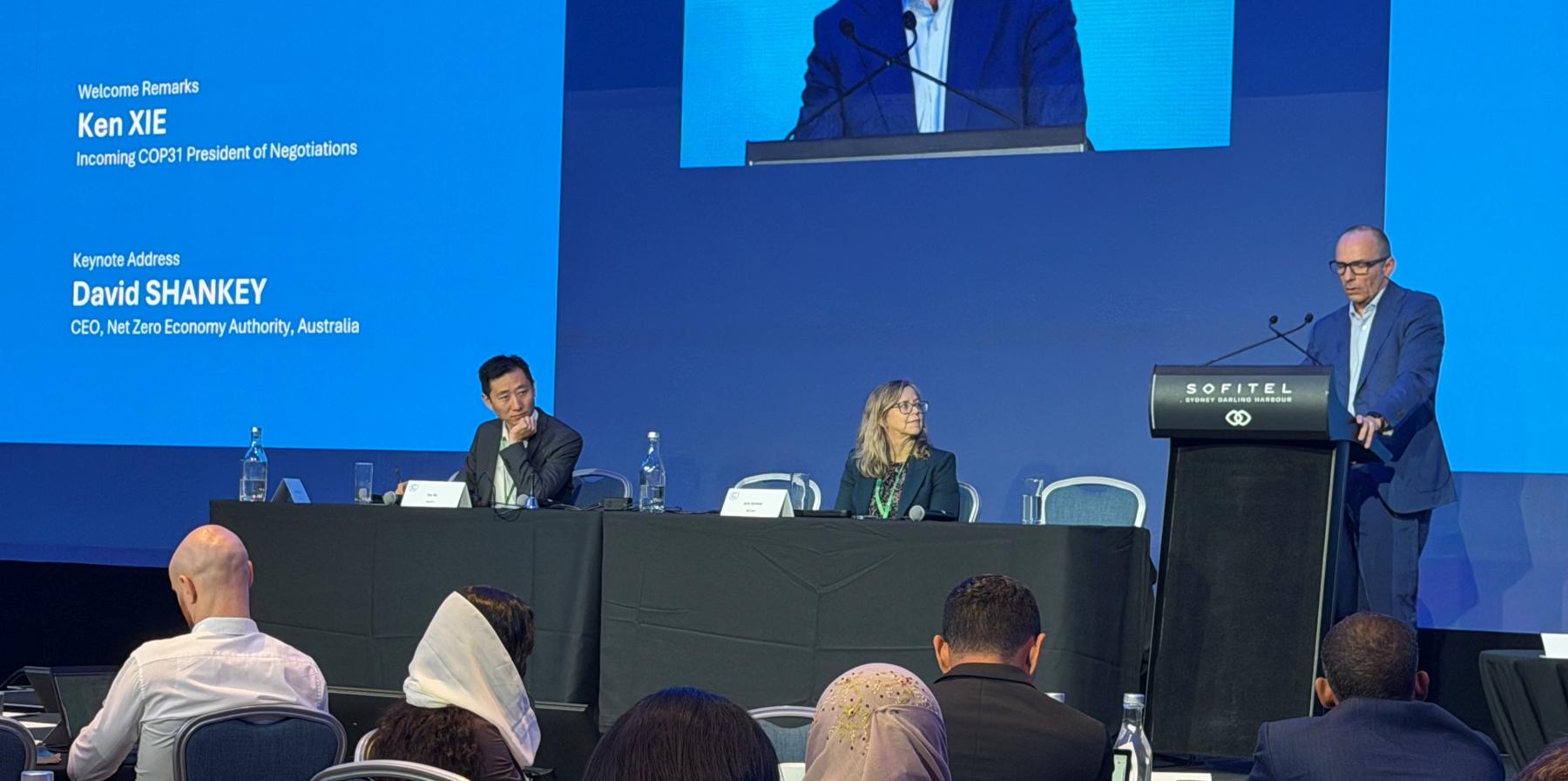
CHECK AGAINST DELIVERY
Good evening. I’m David Shankey, CEO of Australia’s Net Zero Economy Authority. I’ve come from Canberra this afternoon, where our Board has been meeting. It is great to be here with people wrestling with many of the same questions that occupy us every day at the authority.
I suspect one thing we would all agree on is that 'just transition' is much easier to describe than it is to deliver. We can agree that workers should have opportunities, that communities should have a voice, that regions should share in the economic benefits of the transition and that nobody should be left behind.
But once you move from the principle to the place, things become more complicated. Economic change does not happen on a whiteboard. It happens in places with histories, culture and identities often shaped by the industries that are transitioning. It happens in communities where generations of families have worked in the same industries. It happens with businesses that depend on those industries, to workers making decisions about bills to pay and raising their children and whether they need to retrain, and to communities wondering about the future of their community and whether the next generation will have a reason to stay. That is the territory Australia’s Net Zero Economy Authority was created to work in.
Our mandate is to promote orderly and positive economic transformation and to make sure that regions, communities and workers are supported to manage the impacts of the transition and share in its benefits. For us, that means supporting workers in coal and gas facilities as they prepare for change and helping them move towards new, well-paid, safe and secure jobs. It means working with communities, helping government understand what successful regional transition requires and mobilising those supports to diversity economies and build new opportunities. And we are learning a great deal.
There is a temptation for all of us when talking about transition to explain our own model and explain why everybody else should adopt it. That is not what we are trying to do here.
The more time we spend working in the regions – like Hunter, Collie, Central Queensland and Latrobe-Gippsland – the clearer it becomes that there is no neat template for this work. Every region starts somewhere different. Its economy is different, its workforce is different, its institutions are different and, critically, the people who live there have different ambitions for what their community should become.
But different does not mean unrelated. And there is great scope for Australia to learn from international experiences, and vice versa. There are people in Aberdeen in Scotland thinking about questions that are immediately recognisable to people in the Hunter in New South Wales. Chile has experience that matters to what is happening in Collie in Western Australia. Alberta in Canada and Central Queensland are both major energy-producing regions confronting questions about diversification, workers, investment and emerging industries. South Africa is working through questions around skills, economic diversification and coordinated government action that are highly relevant to our work in Latrobe-Gippsland in Victoria.
The answers will not be identical, and nor should they be. But there is real value of understanding what others have tried, what worked, what did not, and what lessons might translate to a different context. That, really, is where the idea for the International Just Transition Network, which I am proud to announce the formal launch of this evening, began.
The Net Zero Economy Authority and Scotland’s Just Transition Commission have brought together organisations from around the world that are dealing with these questions in practice. The purpose is not complicated: how do we learn from one another while we are doing the work, rather than years later when somebody writes the case study?
The network’s formal mission is to strengthen the practical implementation of just transition through global collaboration. It is voluntary and member-led, bringing together national and sub-national organisations involved in advising on, scrutinising or implementing policies consistent with a just transition.
But I think there is a more human way of describing what we are trying to build. We want a place where people doing difficult work can talk candidly to other people doing difficult work. Not simply about success. In fact, I am probably more interested in the things that did not work — hearing about:
- what you tried and abandoned, and why
- where the policy ambition collided with reality
- what communities told you that you had misunderstood
- what took 3 years that you thought would take 6 months
- and tell us what you would do differently if you were starting again tomorrow.
That knowledge is valuable, and much of it never makes its way into a formal report.
The IJTN is designed to make that exchange possible through practical and technical collaboration and peer-to-peer support. It also explicitly commits members to genuine two-way exchange between developed and developing countries, rather than assuming knowledge travels in one direction.
There is expertise all over the world in managing industrial change. There are communities that have already experienced things Australian communities are only beginning to encounter. If we are serious about doing this well, we should be sufficiently confident to contribute what we know, and sufficiently humble to recognise when somebody else knows more.
The network already includes organisations from Australia, Scotland, Canada, Chile, Nigeria, Ireland, South Africa, Wales, Taiwan and Wales. That gives us a remarkable range of economic, institutional and regional experience. The challenge now is to turn that diversity of experience and wealth of practical knowledge into something useful.
There are already plenty of international conversations about transition. This network needs to earn its keep.
- If an approach developed in another jurisdiction changes something we do in an Australian region for the better, the network has value.
- If an Australian experience helps somebody elsewhere avoid a mistake or overcome a barrier or make faster progress, it has value.
- If a relationship formed through this network means somebody facing a difficult problem knows exactly who to call, it has value.
Ultimately, the test is not whether the network itself succeeds - the test is whether the people and organisations participating in it become better at supporting workers, industries and communities through economic change. That is also why we are being careful about where the network sits in the broader international architecture. The work taking place through the UNFCCC and the development of the Just Transition Mechanism is important. The IJTN is intended to complement and be informed by those processes, as well as the International Labour Organization’s Guidelines for a Just Transition.
We are not establishing another negotiating forum - our focus is what happens when international and national ambition meets local implementation. Because sooner or later every international discussion about just transition arrives somewhere local. It arrives:
- in a workplace
- in a regional economy
- in a training system
- in a community meeting where people quite reasonably want to know what all of this means for them.
And this is where credibility will be either won or lost. That is why this network is focused on practical solutions to common challenges, drawing on the experience of jurisdictions grappling with the same questions in different contexts.
The network has already met in March and July, and our next meeting is scheduled for October. We are deliberately building it with a committed core of organisations and expanding it carefully, including strengthening participation from developing countries. That measured approach is reflected in the network’s current planning. So, tonight is also an invitation.
- If your organisation is doing this work and has experiences to contribute, we want you involved.
- If you are confronting problems that other jurisdictions may already have encountered, bring those too.
- So, if you are interested, please reach out to me, or my colleague, Susan Calvert from NZEA, also here tonight.
And please do not come thinking you need to bring the answer. Bring the difficult questions. Someone else around the table may have spent the past five years trying to answer it.
That, for me, is the opportunity here. We are undertaking one of the largest economic transformations of our time. And the context for many of us is genuinely difficult. Contestation, tight fiscal circumstances and, at times, a limited toolkit to promote change. We can do that as a collection of countries and institutions repeatedly learning the same lessons in isolation, or we can get much better at learning from each other while there is still time for those lessons to matter.
The communities we work with do not particularly care how sophisticated our international architecture is. They care whether:
- there is a future for their town
- there is a good job for their children.
- decisions are being made with them or around them
- and they care whether, when enormous economic change arrives, the people responsible for managing it know what they are doing.
If we can take what has been learned in one community and put it to work in another, then this network will have done something genuinely useful. I look forward to the exchanges throughout this workshop, and through the newly established International Just Transition Network.
Thank you.